From slasher game to horror meeting place
Dead by Daylight launched with only three original Killers and four Survivors. Behaviour's own tenth-anniversary retrospective makes the scale of what followed almost absurd: dozens of characters, original creations and licensed guests now share the same ritual of chases, hooks and escapes.
The important part is that the guests rarely function as passive memorabilia. A famous Killer arrives with mechanical expectations attached. Movement, pressure, range or information can change, which makes the crossover visible in play rather than merely in the character-select screen.
The licenses did not erase Behaviour's own monsters
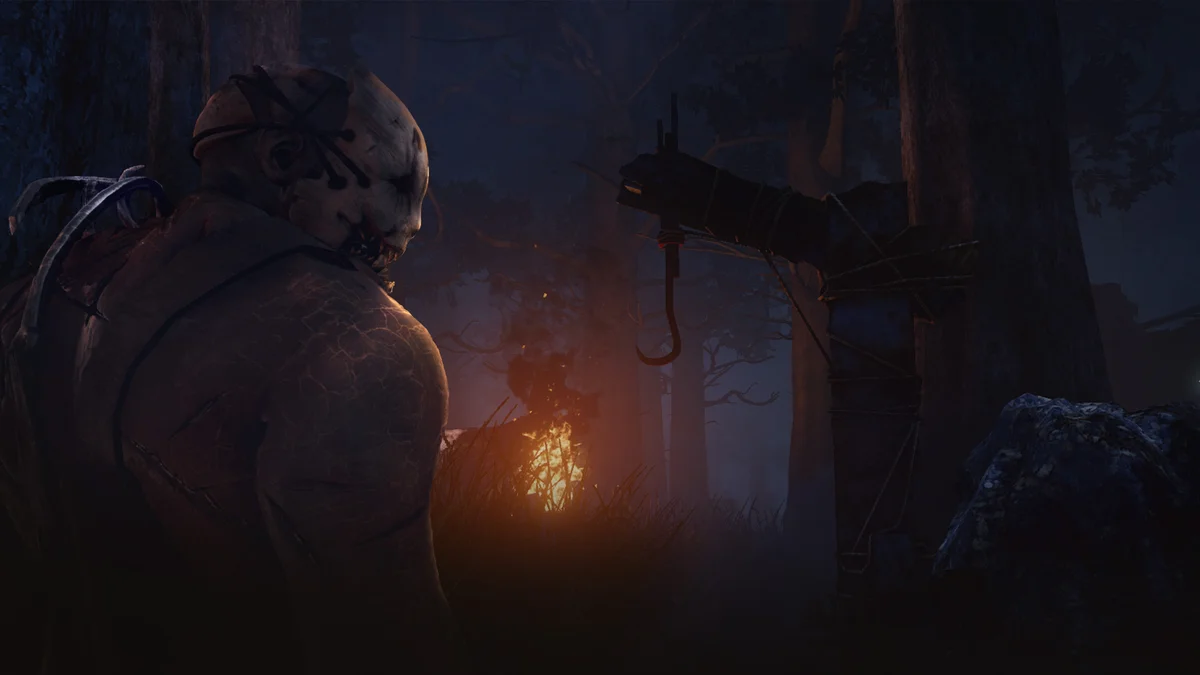
That was never guaranteed. A game containing some of horror's most recognisable faces could easily reduce its original cast to supporting material. Instead, characters such as The Trapper and The Huntress have become recognisable parts of Dead by Daylight's identity in their own right.
Its central fiction helps. The Entity and the Fog provide a convenient explanation for wildly different properties occupying the same space, but after a decade that convenience has become an actual setting. The crossover machine accidentally built a mythology around itself.
Fear gradually gives way to performance
GameSpot praised the game's ability to generate dread from sound, pursuit and bad odds. That quality remains most powerful while the rules are still unfamiliar. Knowledge changes the emotional register.
PC Gamer's later review described a mature competitive layer full of loops, mind games and build decisions. Once those systems become legible, the masked figure across the map can feel less like a monster than a tactical problem.
There is an unavoidable cultural clash there. Dead by Daylight invites players to inhabit a slasher scenario, while a long-running competitive community naturally learns how to optimise it. The better everyone becomes, the more the movie can disappear behind the match.
A ten-year live service with another decade in mind
By 2026, Dead by Daylight's persistence had itself become part of the story. Behaviour used the tenth anniversary to announce further collaborations, experimental modes and a major visual overhaul targeted for 2027 rather than a sequel that would wipe the board clean.
That decision makes sense. The value of Dead by Daylight now lies partly in accumulation: years of characters, rivalries, shared vocabulary and horror properties crossing paths in a place that did not exist for them anywhere else.
The result is messy, commercial and occasionally ridiculous. It is also one of the rare crossover universes whose central game remains interesting after the novelty of seeing a familiar face has worn off.