
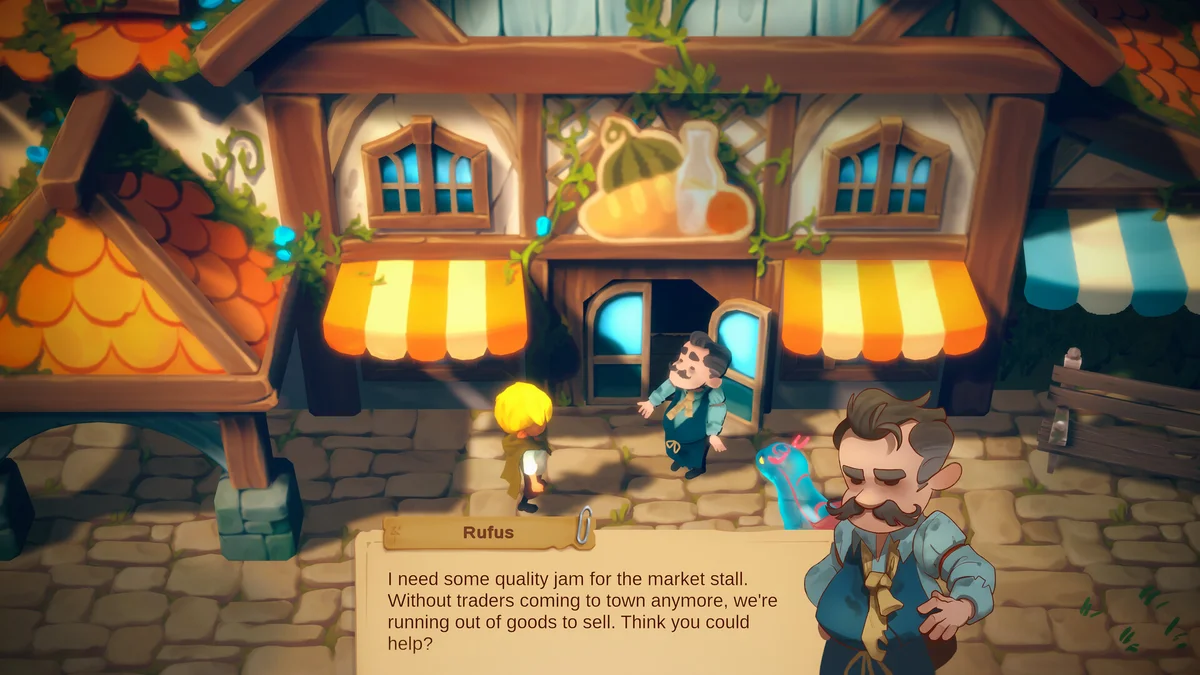
The village is sad, but it is also strangely quiet
The premise works immediately. The protagonist returns to a grandfather's farm and finds an abandoned property, an unhealthy pond and a small community whose energy seems to have vanished along with most of its population. Repairing the farm is therefore meant to trigger a second restoration: rebuilding the village and its morale.
That structure gives chores an understandable purpose. Repairing a stall or supplying food is not simply a way to collect currency; services return and the settlement visibly changes. GameObserver specifically values this gradual process, where the community does not magically recover after one heroic task.
The weakness emerges when the characters themselves need to carry that transformation. PC Gamer found them largely memorable as quest delivery systems after the first season. Bonus Action and Gameliner are harsher, describing consistently miserable townsfolk and dialogue too thin to build convincing personalities.
The dragons succeed where the humans struggle
The creatures establish personality immediately. Their behavior, animation and small play activities communicate character without requiring elaborate conversations. A water dragon helping in the kitchen or moving toward the crops can express more through motion than several villagers manage through multiple resource requests.
That matters because the game's identity depends on restoring the relationship between humans and dragons. Feeding them, playing with them and working beside them gives the creatures practical and emotional presence beyond collectible pets.
The Wand Report identifies an important missed opportunity, however: their trust comes quickly. Rebuilding an ancient relationship between species sounds like a major narrative arc, yet cooperation soon becomes primarily a production system.
Hope is delivered suspiciously often in the form of baked goods
Food is meant to reconnect the community. Meals raise trust, support residents and help restore services. As a metaphor, it is pleasantly direct: taking care of a place begins by taking care of the people living there.
Mechanical repetition eventually weakens that story. When almost every new relationship becomes another order or material requirement, residents begin to resemble a production board with portraits attached.
Even festivals remain heavily focused on cooking according to Gameliner. Dragon Shelter has a coherent theme, but too few narrative pauses — conversations, events, side stories or meaningful exploration — to make the people matter between deliveries.
Awkward localization cannot take all the blame
Steam's official disclosure says generative AI was used only to assist localization and translation, with all localized text reviewed and edited by the developer. That means it would be unfair to assign every weak line automatically to a machine.
What the review corpus does support is that multiple localized builds still contain awkward wording. Games.ch flags strange German quest text, while The Wand Report and Bonus Action criticize the writing more generally.
The distinction is useful because translation is not the deepest narrative problem here. Even when the intent is understandable, the residents simply have too little material with which to become memorable.
Restoration works better as an image than as a drama
There is still something satisfying about watching a neglected place recover its color. The art direction understands the pleasure of cleaning, repairing and seeing life return, while the dragons reinforce that feeling through their presence.
A story about collective renewal ultimately needs people worth caring about, not only buildings with repaired roofs. Dragon Shelter has the ruins and the visual warmth of recovery. It is the conversations that have not yet caught up.