
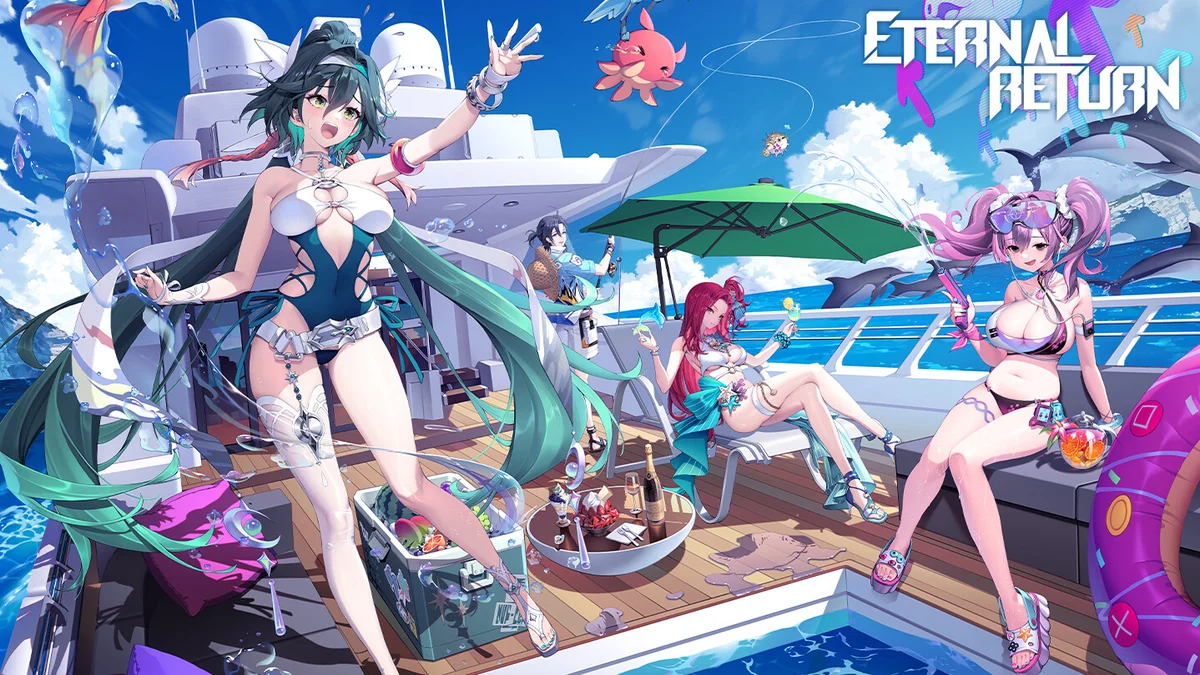
A competitive character needs a readable silhouette
Eternal Return's cast is asked to perform two jobs at once. Characters must be appealing enough to sustain a cosmetic-heavy live service and clear enough to identify in the middle of a fight. The visual design succeeds surprisingly often at both.
Weapons, costumes, posture and animation establish archetypes quickly. The shared anime influence keeps everything inside one visual universe, but the cast still stretches from grounded tactical fighters to musicians, scientists and deliberately eccentric personalities without becoming a shapeless catalogue.
Older reviews repeatedly praised the character art and variety. Voice work is more divisive. Niche Gamer specifically found parts of it excessive, which is not entirely surprising in a game whose characters are designed to communicate personality during repeated matches rather than through a conventional campaign.
The island is a stage before it is a story
AGLAIA's experiments provide the fiction behind Lumia Island, but the match itself rarely stops to dramatize that premise. The island has more urgent responsibilities: distribute crafting materials, create rotation choices, form chokepoints and eventually force surviving squads together.
That leaves story at the edges. Character biographies, relationships and world-building have historically mattered more outside the actual competitive loop than inside it. Eternal Return therefore develops attachment differently from a story-driven RPG. Players learn how a character sounds and moves long before they necessarily learn why that person ended up in the experiment.
Season 12 finally gives the biographies somewhere to live
The Test Subject Records introduced with Season 12 are a meaningful addition precisely because the matches cannot carry all this material. Records include personal information, VF reports, audio records and observation logs, with further analysis progress tied to using a character in Normal or Ranked play.
It is an elegant connection between competitive repetition and lore. Playing a favorite character now has an archival dimension without forcing exposition into the match. The narrative still does not become the main attraction, but the game has become better at preserving it.
The live-service wardrobe is enormous
Seasonal passes, skins and collaborations have turned Eternal Return into a broader character platform. The Persona 5 Royal crossover in 2026 felt aesthetically natural because both games are comfortable with bold silhouettes, stylized fashion and characters sold as personalities as much as mechanics.
The surrounding economy is less elegant than the artwork. Season tokens, passes, boxes, fragments, exchanges and probability tables create considerable menu infrastructure. Patch 12.4 was still changing box contents and probability structures in September 2026.
None of that makes the competitive game pay-to-win in the way equipment sales would. It does make the space around the game feel more commercial than the clean visual logic of an individual character.
Too much personality can become noise
The art direction's biggest weakness appears when several characters use their most elaborate abilities at once. Game8 highlighted combat readability as a genuine issue: effects that look excellent on their own can overlap until important information becomes difficult to isolate.
That is the strange success and failure of Eternal Return's presentation. It has built a cast so visually eager to be noticed that team fights occasionally contain too many things worth noticing.
Outside those moments, the identity is remarkably stable. A character illustration, lobby screen or skin tends to look unmistakably like Eternal Return even before the logo appears.