
Sophia did not need an origin checklist
Prequels have a familiar bad habit: every scar needs an explanation, every object becomes a revelation and every personality trait receives an origin scene.
Resonance mostly avoids that trap.
This is recognizably the woman players will meet fifteen years later in Requiem, but Asobo does not build her story as an encyclopedia of future references.
It is more interested in how a child shaped by a convent, a plunderer father and an unstable community becomes someone capable of surviving on her own terms.
Leni gives the story another human center
Sophia can carry the game, but her relationship with Leni gives the journey warmth and friction.
Their conversations turn long stretches of exploration into character work rather than exposition delivery. Several reviewers identify the pair as one of the story's strengths.
Wccftech raises a fair objection: some of their banter sounds unusually contemporary for the setting.
That matters because historical texture was once one of A Plague Tale's defining qualities.
Crete replaces plague-ridden France
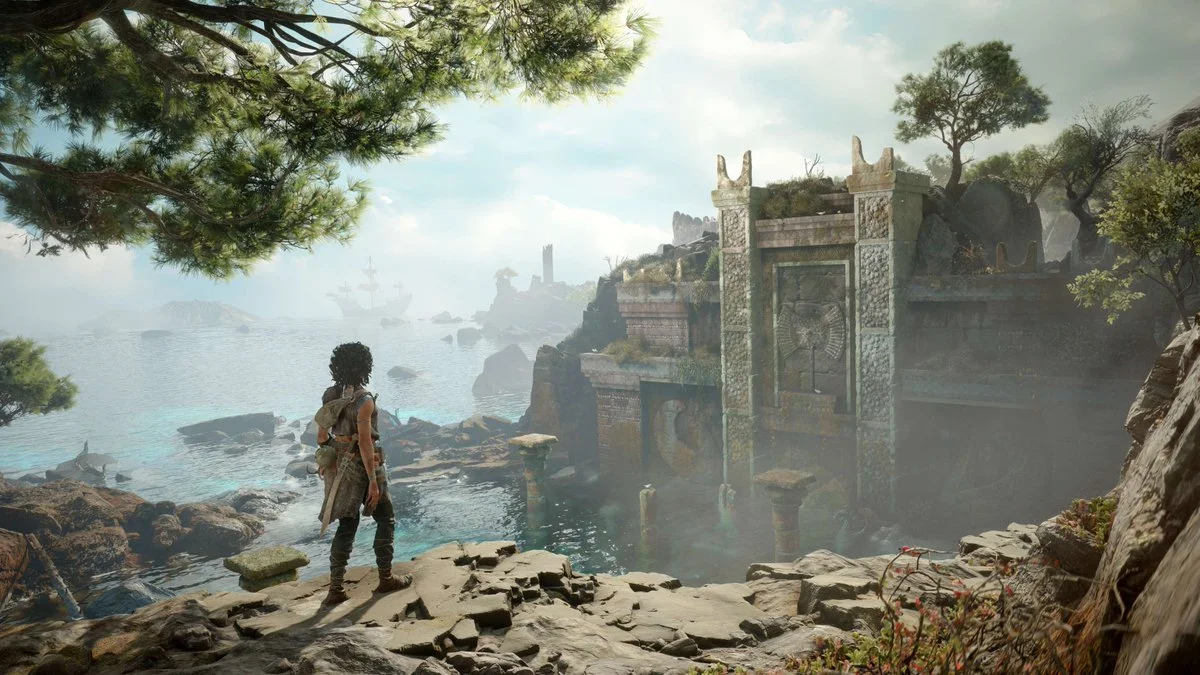
The geographical shift is enormous. Resonance trades much of the mud, disease and ruined French countryside for Mediterranean light, Minoan architecture, labyrinths and the iconography of the Minotaur.
The Guardian's review is particularly attentive to this material, from the landscapes to the frescoes and classical references.
Asobo consequently produces a far brighter-looking game without making the world feel safe.
The island is beautiful because its beauty is constantly surrounded by evidence that something went terribly wrong there.
Two timelines give the ruins memory
The story alternates between medieval Sophia and a much older Minoan narrative involving Theseus. Places, actions and mechanisms echo between the two periods.
It could have been a gimmick.
Instead, it gives the island a sense of historical consequence. Ruins are not simply puzzle rooms waiting for Sophia to arrive; they are remnants of another tragedy.
Windows Central considers this relationship between Minoan mythology and A Plague Tale lore one of Resonance's strongest ideas.
The Macula is becoming mythology rather than mystery
This is where the series' evolution becomes impossible to ignore.
Innocence balanced historical horror with supernatural elements. Requiem already pushed much further into the Macula's mythology. Resonance goes further again.
Sophia's visions, Theseus, the island and the central creature openly move the story toward fantasy.
Some reviewers welcome the larger mythological scope. Wccftech argues that the shift sacrifices part of the specific historical identity the earlier games possessed.
Both reactions make sense.
Not every revelation survives scrutiny
The plot occasionally bends its own rules for convenience. PlayStation Universe points to the awkward logic surrounding supposedly essential tools for navigating the island when other characters appear able to reach advanced locations through much simpler means.
It is not enough to break the story, but it briefly exposes the machinery underneath it.
Some franchise-lore revelations also feel designed to produce recognition in players who know Requiem.
Fortunately, Sophia's story does not depend entirely on those connections.
Emotion remains the real Plague Tale legacy
PCGamesN describes Asobo as returning to narrative excellence and emphasizes how emotionally punishing the story becomes. PlayStation Universe and Destructoid are similarly enthusiastic about the dramatic arc.
That consensus matters more than whether Resonance contains enough rats.
A Plague Tale has never worked solely because Asobo could put thousands of creatures on screen. It works when characters matter enough that catastrophe has a personal cost.
Resonance understands that inheritance.
A prequel that does not feel trapped by the future
Sophia inevitably becomes the person players already know. That does not make every step toward that destination predictable.
The game expands the Macula, enriches Sophia and gives Asobo a distinctly different mythological space without existing solely to prepare Requiem.
It loses some of the grounded historical flavor of the series' beginnings.
In exchange, it proves Sophia was never merely a useful supporting character.