
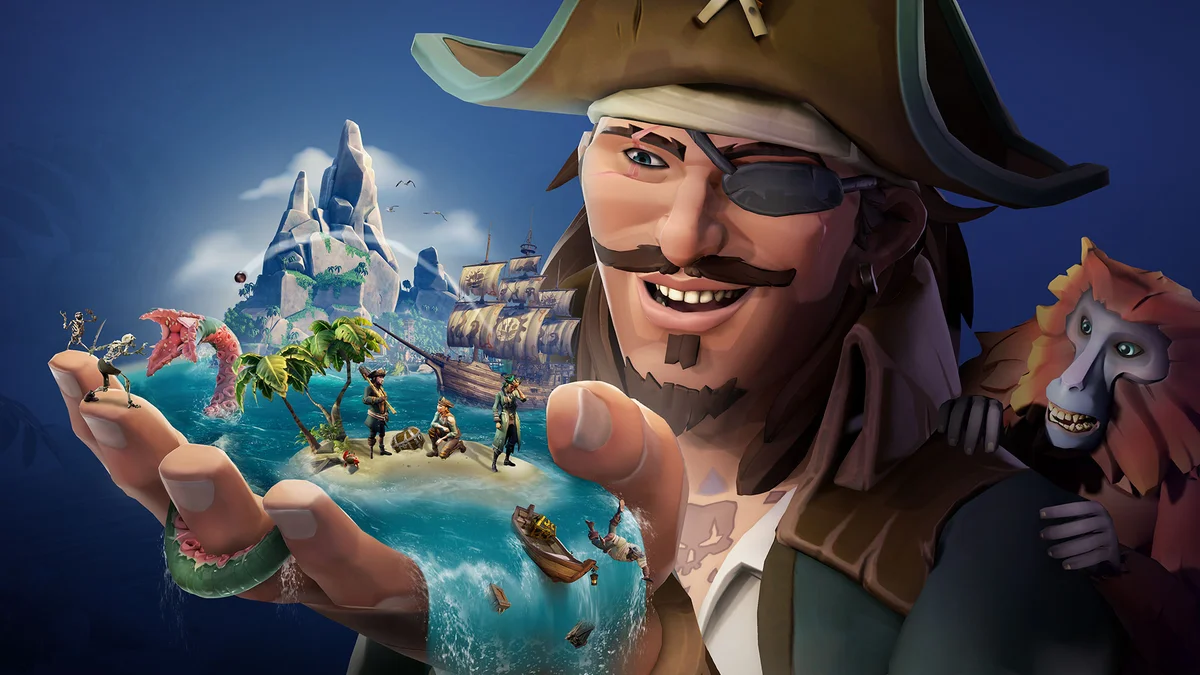
A sunset should not matter this much in Sea of Thieves. It unlocks nothing, improves no statistic and does not complete a challenge. Yet reviews repeatedly end up discussing the water, the light, the horizon and crews pulling out instruments during otherwise uneventful journeys.
Rare understood that the world needed to feel good before anything happened in it.
The scenery creates room for stories
Sea of Thieves' stylised art direction has aged unusually well. Push Square still treated the presentation as a major strength of the PS5 release in 2024, while GamingBolt similarly praised the ocean, environments and general atmosphere.
The physical ship is part of that identity. Pirates walk to the wheel, read the map below deck, climb masts, play music and perform small actions that make the vessel feel like a place rather than a matchmaking lobby.
Then another sail appears.
A silhouette is enough to create tension
Another crew might be friendly, distracted or extremely interested in the treasure below your deck. Sea of Thieves usually refuses to answer that question until the ships are close enough for the answer to become dangerous.
GameSpot identified those emergent player interactions as the defining strength even when the launch game itself was criticised for being sparse. By the 2020 reassessment, Rare had added enough overlapping systems to create far more reasons for crews to cooperate, compete and betray one another.
That uncertainty produces a form of storytelling difficult to manufacture through cutscenes. Treasure matters because it can be stolen. Cooperation becomes memorable because trust is optional.
The authored stories eventually caught up
Tall Tales gave Sea of Thieves more conventional narrative adventures, recurring characters and structured journeys. Additional seasons, factions and themed updates gradually gave the world more history and context.
They work best as destinations rather than replacements for emergent play. Rare provides a reason to sail somewhere; the journey can still become the part people remember.
GamingBolt's 2024 PS5 review effectively treats the modern game as evidence of a successful long-term recovery from the limited launch version.
Not every pirate story is a pleasant one
The same social freedom creates uneven evenings. Losing valuable cargo after a long session can be genuinely frustrating, and repeated activities show more of their structure when pursued mainly for cosmetic milestones.
On-foot combat remains comparatively plain. Swordplay and shooting generate slapstick, but they lack the mechanical character of a naval battle in which three simultaneous problems can sink a ship.
A service game that learned to give players space
Custom Seas feels like a logical 2026 extension. Private groups can now organise sessions for up to 24 players and reshape parts of the sandbox for their own events.
Rare spent years watching players create stories from systems that were never fully predictable. Now it is handing them more control over the stage.
That is why Sea of Thieves earns 9/10 here. It has lore, authored adventures and an increasingly broad catalogue of content, but its most distinctive cultural achievement remains the story somebody tells the next day about the completely avoidable disaster that happened between two islands.