Warhammer 40K without mandatory homework
Space Marine 2 begins with a protagonist carrying roughly two centuries of baggage. Titus saved Graia, was denounced to the Inquisition, disappeared from his Chapter and spent years serving in the Deathwatch. For a newcomer, that could have been disastrous.
Saber wisely refuses to explain every proper noun. Polygon noted how accessible the game remains despite the density of the setting. The essential information is simple: Titus has returned to the Ultramarines under complicated circumstances, the Tyranids consume worlds, and the Imperium is a deeply unpleasant civilisation.
Most of the rest is left on the screen.
Scale becomes storytelling
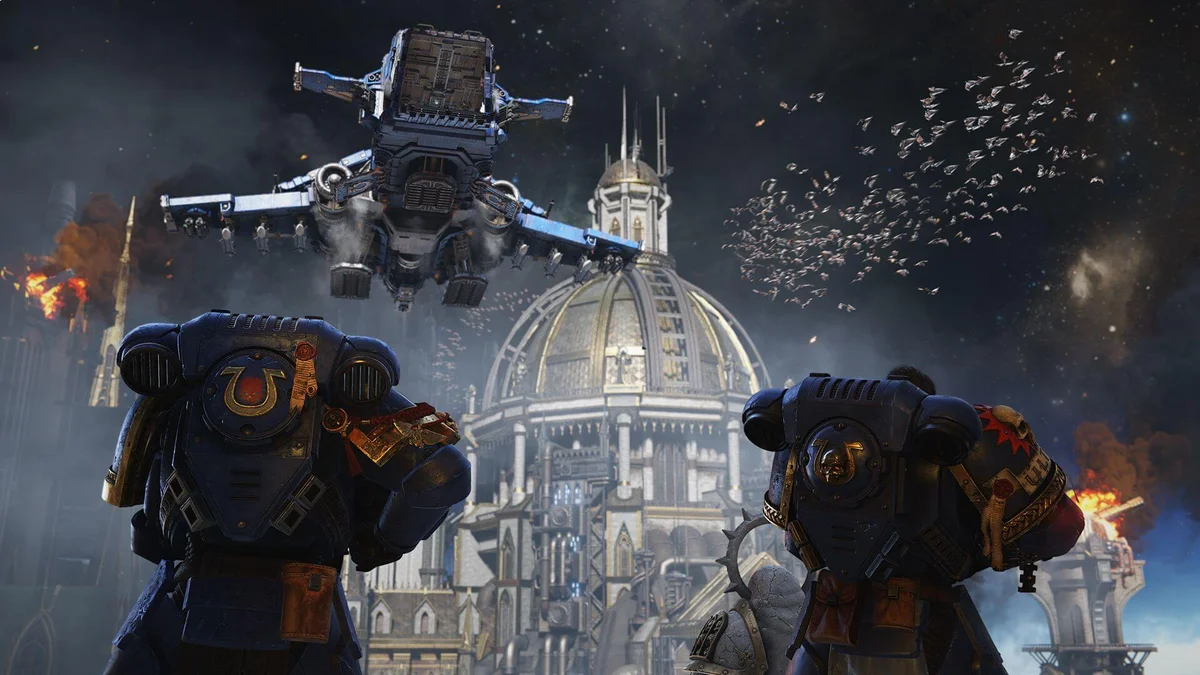
Space Marine 2 is strongest when Titus appears gigantic beside an ordinary guardsman and tiny beside the war itself. Regiments fight beyond the playable space. Gargoyles cover the sky. Artillery fires toward battles the player will never reach.
GameSpot and GamesRadar both emphasised this sense of scale. It is more than visual spectacle because absurd size is fundamental to Warhammer 40K. Cities resemble industrial cathedrals, religion is embedded in machinery and every military structure appears designed by somebody who believed moderation was heresy.
Titus is emotionally armoured too
The character drama is less successful. Gadriel distrusts Titus, Chairon carries his own history and Titus responds to most emotional pressure by becoming even less communicative.
GamesRadar considered the overall story shallow. Polygon found more value in Titus' redemption arc but also identified threads that appear ready for meaningful development before simply disappearing.
The stiffness suits indoctrinated transhuman soldiers. That does not automatically make every conversation interesting.
The Tyranids explain the war through movement
The first half has the perfect antagonist for this kind of adaptation. Tyranids need almost no exposition. Thousands of bodies pouring over fortifications communicate their purpose immediately.
The Thousand Sons bring richer lore later: Chaos, sorcery, the Warp and ten thousand years of betrayal arrive with them. For experienced fans, the shift is loaded with meaning.
Structurally, it is less successful. Push Square and Polygon both found that the second half loses some of the clarity of the original Tyranid conflict.
The Imperium is mostly allowed to remain spectacular
Space Marine 2 constantly shows evidence that the Imperium is horrifying. Commissars punish soldiers, humans are repurposed into machinery, religious symbols cover industrial systems and authoritarian violence is completely normalised.
The game rarely stops long enough to interrogate that civilisation. Titus is an Imperial weapon, so the story naturally inherits his military perspective.
The bolter usually wins the argument before politics has time to begin.
The environment does the heavy narrative lifting
That restraint is also why the adaptation is so accessible. New players can ignore the significance of individual Chapters, machinery and rituals. Fans can recognise them without the game stopping to congratulate itself.
Space Marine 2's central story is serviceable rather than extraordinary.
Its ability to make Warhammer 40,000 feel physical is much harder to dismiss.