
A factory with somebody waiting at the other end
Automation games often create a closed loop: extract to manufacture, manufacture to build, build to extract more. The Crust tries to break that loop by placing Earth at the end of the production line.
Contracts are economic mechanics, but they also keep the lunar colony connected to a wider crisis. Competing organisations request resources, relationships change and campaign choices give industrial output a political context. The factory stops feeling like an isolated puzzle placed on a Moon texture.
Version 1.0 finally gives the systems a destination
InsertCoins treats the completed campaign and multiple endings as one of the defining additions of the full release. Early Access already contained a large collection of mechanics, but the overall journey could feel unfinished because those systems were preparing for a destination that had not yet arrived.
The full release closes that gap. Campaign players now have an arc to follow, while Sandbox 2.0 gives builders a way to ignore the story and concentrate on engineering.
That split is useful because the two audiences genuinely want different things. Respawn.pl notes that some players value narrative direction while others experience imposed objectives as interference with the colony they wanted to design.
Colonists stop the Moon from becoming a spreadsheet
Health, mood, skills, employment and living conditions turn the workforce into more than a population counter. The systems are still managerial first, but they change the tone of expansion. Housing and social infrastructure are no longer decorative modules sitting beside the real factory.
They are part of the factory because the people operating the colony have to survive inside it.
The machines are more convincing than the conversations
The narrative execution is less consistent. Game Atlas reports uneven pacing, stiff dialogue and poor localisation in several languages. Those weaknesses matter more here than they would in a completely abstract builder because The Crust actively asks the player to care about the wider world.
PC Gamer was harsher about the Early Access character presentation and voices. The finished game has moved considerably since that 2024 build, including additional voice work, yet the comparison still exposes where VEOM Studio appears most comfortable: systems first, drama second.
Industrial loneliness carries much of the atmosphere
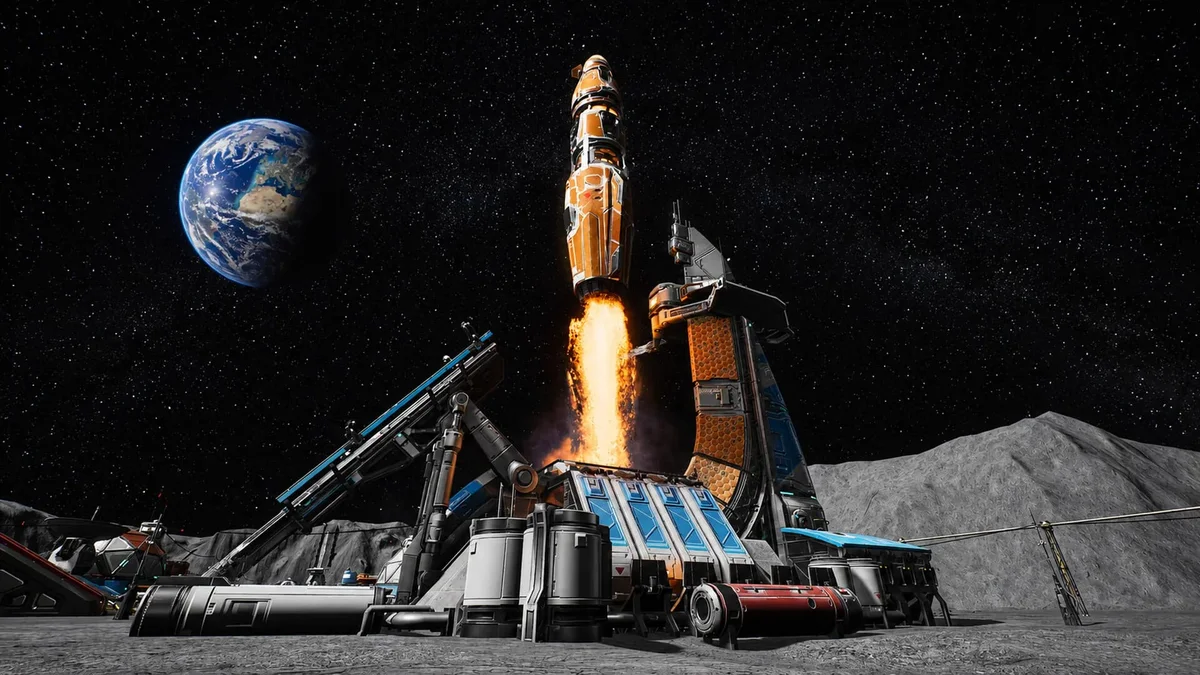
Fortunately, the setting communicates even when nobody is talking. Orange-and-white machinery spreads across grey regolith. Vehicles crawl between buildings while Earth hangs at a distance. Underground production spaces become increasingly dense and artificial.
The soundtrack reinforces that contrast, and the result gives The Crust a stronger identity than its individual conversations sometimes manage.
Its story works best at this larger scale: a desperate planet, competing organisations and a colony turning a dead landscape into an industrial lifeline one conveyor at a time.