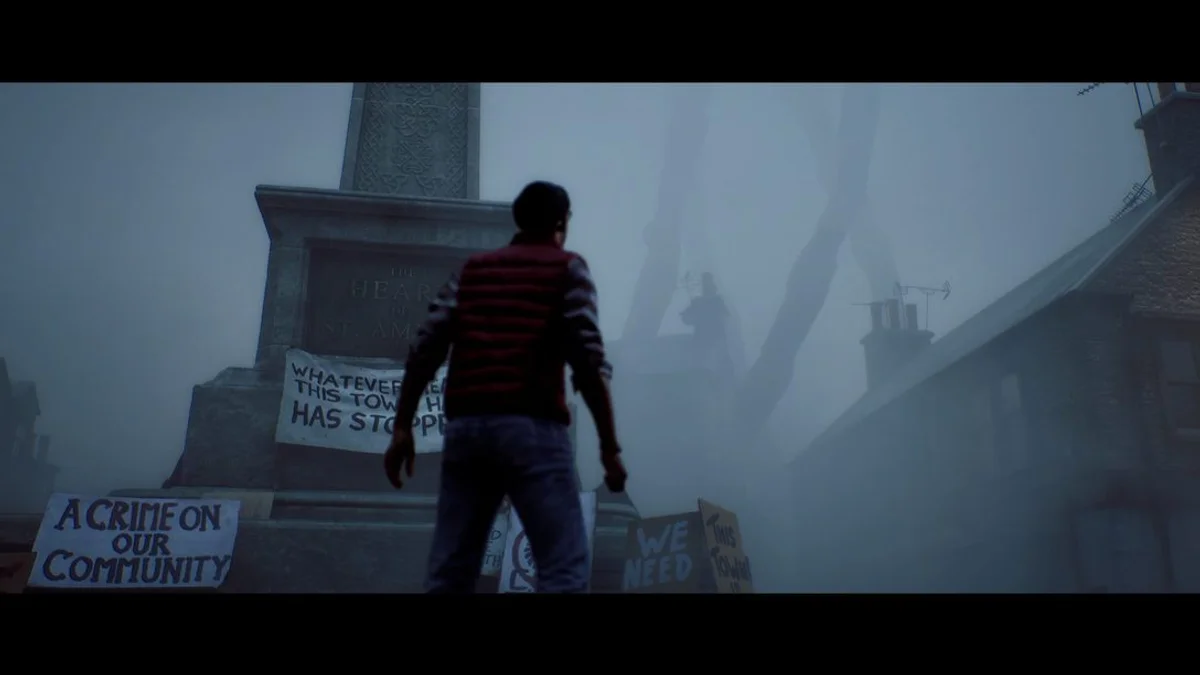
SILENT HILL: Townfall follows Simon Ordell through St. Amelia, a fictional Scottish island in 1996. Screen Burn Interactive is developing the game in Edinburgh, with Konami and Annapurna Interactive publishing.
Scotland is not being used simply as an unusual backdrop. Jon McKellan and the Screen Burn team have described building St. Amelia from local details, memories and lived experience so its streets feel as though they belonged to a real community.
This town is not an ancient ruin
Something happened to St. Amelia, but it does not look like somewhere abandoned for an entire generation.
Buildings, shops, homes and public spaces still carry signs of recent life. That changes the emptiness. The player is not merely walking through ruins; it feels as if the people who lived there disappeared shortly before Simon arrived.
Screen Burn wants players to understand what that community represented before fully explaining how it was damaged.
Loss carries more weight when the place still looks like something somebody might have tried to save.
1996 lets technology become frightening in a different way
The CRTV crystallizes the period setting. Simon carries a small analogue television that has to be tuned to receive audio and video signals.
The object draws on a very specific 1990s visual language: static, weak channels, antennas, low-resolution displays and the suggestion that an unknown transmission may exist between frequencies.
Townfall turns that imagery into a mechanic. Pieces of the past appear through the screen, creatures can be located with it and certain puzzles depend on understanding what the device is receiving.
Silent Hill's radio traditionally made players afraid of what they could not see. Townfall creates the opposite problem as well: sometimes looking is worse.
Simon does not fully understand why he returned
The protagonist washes up on St. Amelia believing he has to “put things right.” Zoe, a local nurse, appears to know him even though Simon does not recognize her or the island.
That contradiction is central to the mystery. Trailers have shown memories and transmissions that do not neatly agree with Simon's understanding of his own history.
Richard is the other named figure Screen Burn directly connects to the island's events, while the exact relationship between the three remains deliberately unresolved.
The mystery is therefore not only what happened to St. Amelia. It is whether the person investigating it can trust his own memories.
Screen Burn is looking beyond individual guilt
The studio describes Townfall as particularly interested in the relationship between the individual, corporations and society.
That is recognizably Silent Hill territory without simply repeating Silent Hill 2. The series has long turned guilt, repression and trauma into places and creatures; Townfall appears to widen the frame toward what communities and institutions can do to people.
Its puzzles are part of that structure. Screen Burn says they were developed alongside the narrative so solving them reveals something about people, places or events rather than functioning as detached locks between story scenes.
First person changes the distance between player and horror
Everything is experienced through Simon's eyes. There is no player-character body positioned between the audience and the thing standing in front of them.
The narrower field of view makes sound crucial. Screen Burn's 3D audio work places noises around the player so threats can exist outside the visible frame long before they appear.
Some enemies can be fought. Others force evasion, stealth or waiting.
The result looks less like an attempt to turn Silent Hill into an FPS than an attempt to remove the safety of spectatorship. Players do not watch Simon enter the room. They have to enter with him.
Townfall arrives while the series is finally refusing to stand still
Konami has now built three consecutive autumn releases around Silent Hill: the Silent Hill 2 remake in 2024, Silent Hill f in 2025 and Townfall in 2026.
They do not follow the same creative model. One revisits a classic, another moves the series to Japan, while Townfall hands psychological horror to a small narrative studio building an entirely first-person Scottish story.
The game launches September 24 on PS5 and PC.
The fog remains. Everything else is allowed to move.