
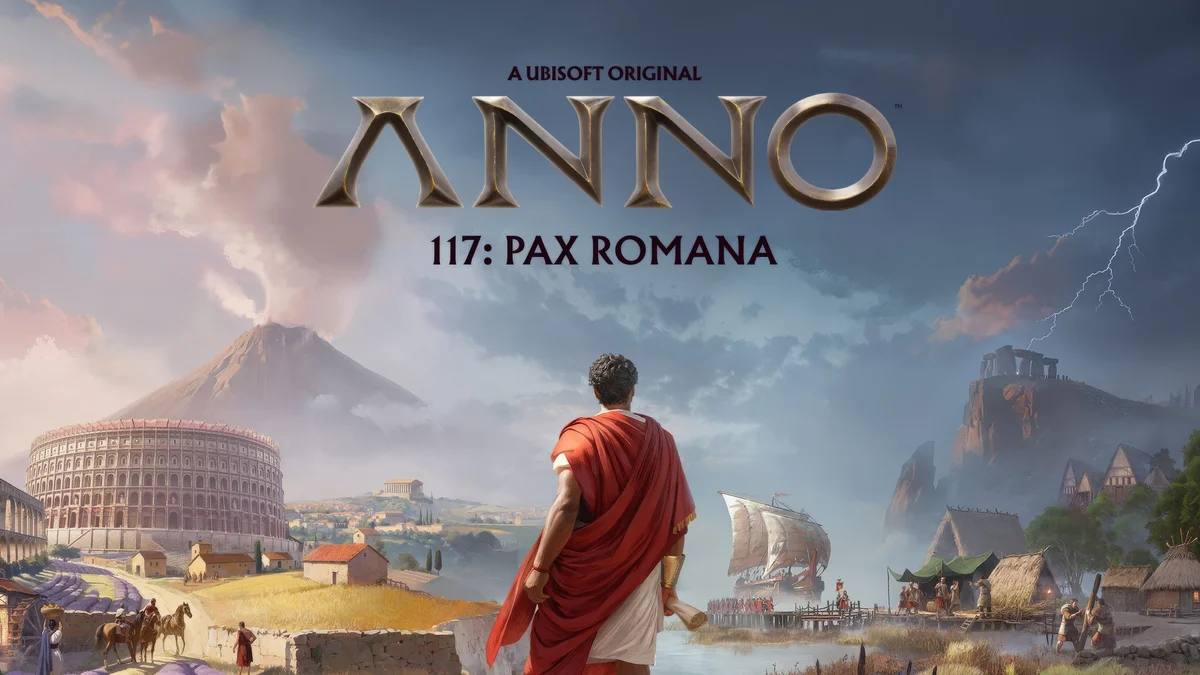
This time the governor has a name
Anno has told stories before, but Pax Romana goes further by asking players to choose between two defined protagonists. Marcus Naukratius is the younger son of a provincial governor with experience in imperial grain logistics. Marcia Tertia comes from the same household but begins from very different social expectations.
Ubisoft uses those backgrounds to personalize parts of the campaign without creating two entirely separate games. GameSpew responds particularly well to Marcia and the political drama surrounding her.
The difference remains subtle enough that Anno never becomes a role-playing game. The governor simply has more presence inside the world being governed.
Juliana first presents the reassuring version of Rome
The campaign begins with rebuilding an almost abandoned settlement near Rome. Latium is given every opportunity to display the familiar imagery: paved roads, Mediterranean agriculture, villas, temples, plazas and institutions.
Story progression doubles as onboarding. Needs, resources and diplomacy arrive in a controlled sequence.
That is also where reviewers diverge. GameSpew finds the drama engaging, while GamesRadar sees the campaign mostly as a functional teaching structure.
Exile to Albion finally gives the journey meaningful contrast
After a dramatic change in imperial power, the governor is sent north. Albion replaces Latium's sunlight with rain, mist, cliffs and wetlands.
The contrast is not merely visual. Celtic populations already inhabit the region, and the game gradually asks whether their traditions should be integrated or displaced by stricter Romanization.
Ubisoft explicitly frames that tension as part of the governor's identity. It gives city planning an opportunity to become a cultural decision.
Rome works better as a place than as a history lesson
GamesRadar identifies an important limitation: foundational aspects of Roman society, including slavery, are acknowledged more readily than explored.
Pax Romana generally chooses an approachable and comparatively warm tone. That makes sense for a city builder designed around long, contemplative sessions, but it creates a gap between economic sophistication and historical caution.
The game is ultimately more comfortable discussing the movement of goods than the movement of power.
Citizens perform an enormous amount of storytelling without speaking
PC Gamer, TechRadar, IGN and GameSpew all emphasize how convincing the cities become at close range. Zooming in makes districts stop looking like abstract collections of statistics.
Citizens, markets, temples, amphitheaters, roads, aqueducts and daily routines fill the screen. Close inspection can reward a beautiful layout even when it is not mathematically optimal.
That may be where the Roman setting works best. Players begin by building for numbers and eventually look at the result as though it were a real place.
The emperor gives a face to traditional Anno pressure
Lucius and later Calidus turn system demands into a more recognizable relationship with authority. Loyalty, diplomacy and governance decisions influence the governor's standing with imperial power.
Julia later represents a more culturally integrative approach, providing narrative justification for different ways of governing Albion.
These characters never reach the complexity of a dedicated narrative RPG. They do make political and economic decisions feel less like anonymous menu entries.
The most convincing story begins after the campaign stops
Once the two campaign acts conclude, the same world continues in sandbox form. Cities, relationships and previous decisions remain while the script stops dictating the next objective.
That is where Anno's own form of narrative takes over: a shortage causes another colony, the colony requires a trade route, the route creates a conflict and a former partner becomes a rival.
The strongest memories in Pax Romana therefore do not necessarily come from written scenes. They come from cities remembering what happened to them.