
Bodycam has almost no conventional plot, no meaningful cast and barely any fictional world to explain. On paper, that should leave very little to discuss beyond mechanics.
Instead, its perspective gives ordinary multiplayer violence an unusually specific cultural texture.
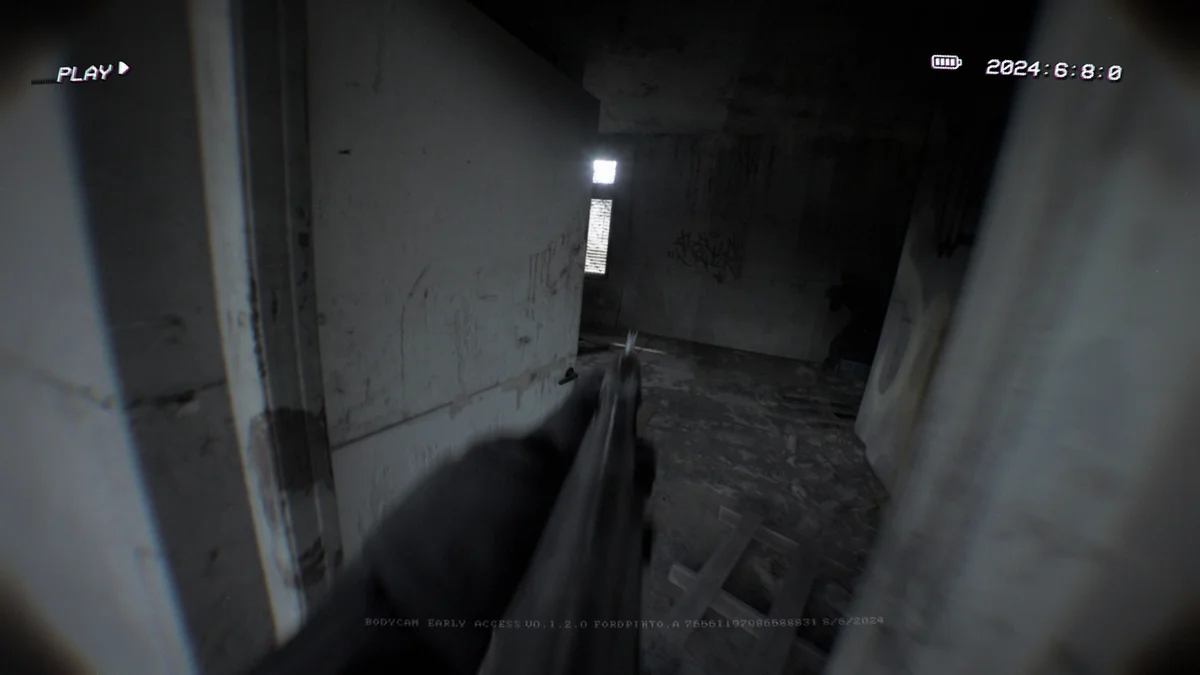
Call of Duty frequently turns warfare into action cinema. Rainbow Six Siege converts it into a highly legible competitive space. Bodycam deliberately resembles footage that was captured rather than staged, borrowing the visual language of documentary clips, social media and modern conflict recordings.
The image wants to look captured, not composed
The lens bends. Bright sources blow out. Darkness genuinely destroys information. Camera movement refuses the clean stability games normally provide to keep action comfortable.
Death is similarly abrupt. The image drops with the body or disappears.
PC Gamer described the launch experience as closer to horror than a competitive shooter, and the observation remains useful. Walking through Bodycam often produces the suspicion that an enemy is already visible somewhere in the frame and you simply have not recognized the silhouette yet.
It does not need monsters to become frightening
Bodycam now includes Zombies, but its strongest horror rarely depends on creatures.
A dark room, muffled footsteps and a flashlight crossing a doorway can be enough. The extremely aggressive gunfire then ruptures that quiet with almost physical force.
This is where the presentation becomes more than a filter. Poor visibility itself becomes a dramatic device.
Eventually you begin to recognize the videogame underneath
The illusion inevitably changes after enough matches. Maps become familiar. Optical artifacts become rules rather than surprises. Players learn spawns, sightlines and habits.
What remains underneath is an easily recognizable list of multiplayer structures: Deathmatch, Team Deathmatch, Hardpoint, Gun Game, Body Bomb and Wingman.
There is nothing inherently wrong with familiarity, but it creates a strange gap between a radical image and a relatively conventional game.
Bodycam can look like a new language wrapped around an old sentence.
Locked & Loaded makes that sentence more interesting
The September 2026 overhaul extends the fiction of the camera into more interactions. Procedural weapon handling, stress-dependent reload behavior, FPV drones and the tactical tablet all give physical texture to actions that previously felt thinner.
The new Trenches map also carries a more loaded contemporary visual vocabulary than an abstract arena, moving between claustrophobic passages and exposed long-distance lines.
These additions bring the game closer to the experience its visual language has always promised.
Bodycam is still stronger moment to moment than over time
The critical consensus has consistently praised its first impression while questioning how long the effect survives repetition. GamingBolt raised that concern in 2024, and more recent post-update reviews continue to identify limited long-term depth as one of the game's main weaknesses.
That is the central limitation.
Bodycam has very little to say about who these people are, where they are fighting or why the conflict exists. Almost everything happens through presentation rather than fiction.
The presentation remains extraordinary.