Borderlands 4 sometimes feels like a series that reread every complaint about Borderlands 3 and deliberately moved in the opposite direction.
Fewer villains constantly interrupting the action. Fewer jokes desperate to become memes. Fewer characters filling every second of silence.
The restraint improves the experience substantially. It also creates the game's most interesting critical disagreement.
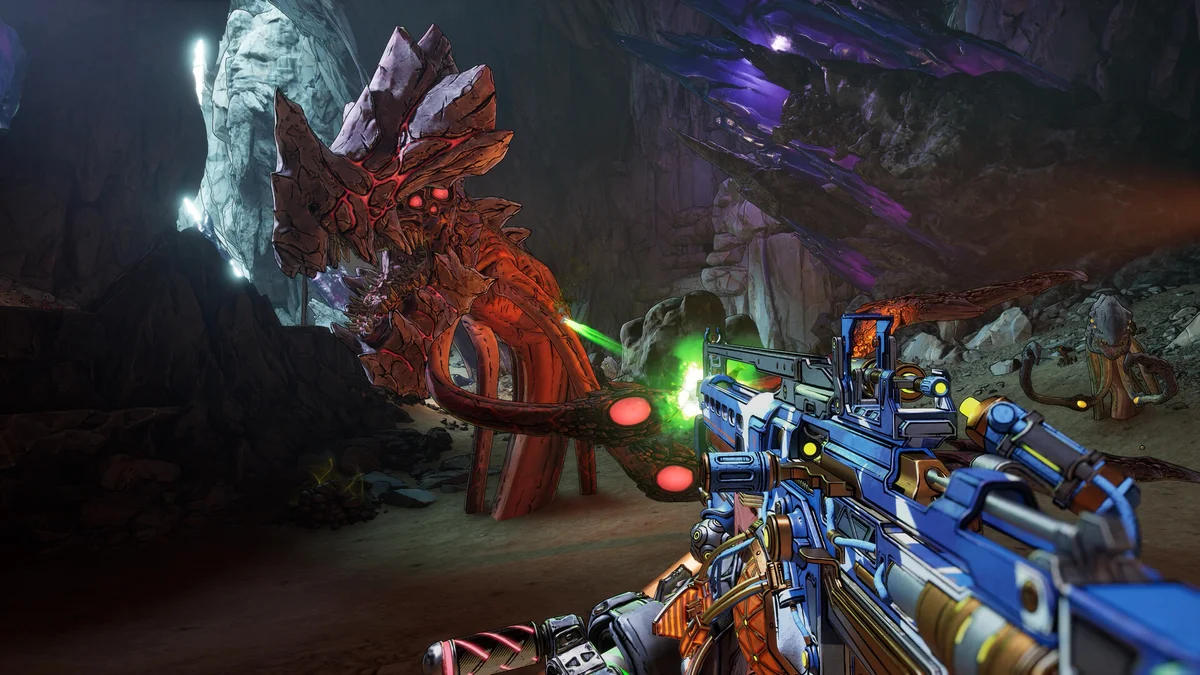
Kairos finally feels like a place rather than a sequence of maps
The prison planet is ruled by the Timekeeper, an authoritarian figure obsessed with order who uses implants to monitor and control the population.
Its four broad regions have distinct geography, factions and political circumstances.
The connected structure helps enormously. Previous Borderlands worlds could feel like spectacular sets separated by loading screens; Kairos possesses more continuity.
The Guardian particularly praised the series' newfound maturity and a story that becomes stranger and more engaging after a conventional opening.
The Timekeeper is calmer than the Calypso Twins, sometimes too calm
Gearbox deliberately moves away from Borderlands 3's constant antagonistic noise.
The Timekeeper's menace is rooted more in control than attention-seeking comedy, which is a sensible correction.
GameSpot argues that the correction goes too far. Characters become difficult to hate because they are rarely obnoxious, but also difficult to love because so many lack memorable edges.
That is the central narrative trade-off. Borderlands 4 is less irritating than its predecessor. It is not automatically more memorable.
The protagonist's personal motivation fades too quickly
The opening establishes an effective hook: the Timekeeper implants the Vault Hunter with technology capable of tracking and controlling them.
That could have created an intensely personal objective.
The threat is quickly mitigated by ECHO-4, and the protagonist is almost immediately absorbed into the Crimson Resistance.
GameSpot correctly identifies how quickly the personal stakes dissolve into a cause the hero has barely encountered.
Critics disagree sharply about the writing
This is the most useful disagreement in the review corpus.
GameSpot finds the cast bland. TechRadar calls the writing genuinely good and even celebrates a more tolerable Claptrap. The Guardian argues that Borderlands has finally grown up without abandoning its identity.
That split suggests an identity change more than a straightforward failure.
Players who define Borderlands through relentless comic aggression may find the fourth game too restrained. Players exhausted by Borderlands 3 may feel somebody finally removed the megaphone from the writers' room.
Returning characters are used with more restraint
Moxxi, Zane, Amara and Claptrap return, but Kairos generally avoids turning them into an endless parade of nostalgia.
That gives the new factions room to exist and prevents the planet from becoming a museum for previous games.
The trade-off is that many newcomers lack the immediate personality of the series' strongest historical characters.
The comedy improves when it stops demanding applause
Borderlands remains full of absurd names, grotesque situations and jokes that deliberately push too far.
The key difference is pacing.
A failed joke can now simply fail and disappear instead of being followed by another character explaining the joke and a third character reacting to it.
That breathing room may be the game's most important tonal improvement.
The open world contributes to storytelling
Kairos' regions directly communicate the effects of the Timekeeper's regime through resource control, isolated settlements and militarized infrastructure.
This is not suddenly a sophisticated political RPG. Borderlands still prefers solving ideology with a shotgun.
But environmental continuity gives Kairos more cultural identity than another hour of exposition would.
Post-launch content extends Kairos rather than rewriting the original campaign
Gearbox has added Bounty Packs, Story Packs and additional Vault Hunters throughout the year since launch.
That ongoing support makes Kairos larger in 2026, but it should not be treated as a retroactive fix for the original campaign.
The base story remains a calmer and more coherent Borderlands that occasionally becomes surprisingly smooth-edged.
Growing up is not the same as becoming unforgettable
Borderlands 4 deserves credit for recognizing that franchise identity cannot be measured in jokes per minute.
Kairos has more presence than many previous settings, and the campaign is substantially less exhausting than Borderlands 3.
Gearbox occasionally confuses restraint with dramatic flatness, however.
Borderlands 4 is better company for thirty hours. It produces fewer characters and scenes likely to be quoted for the next decade.