
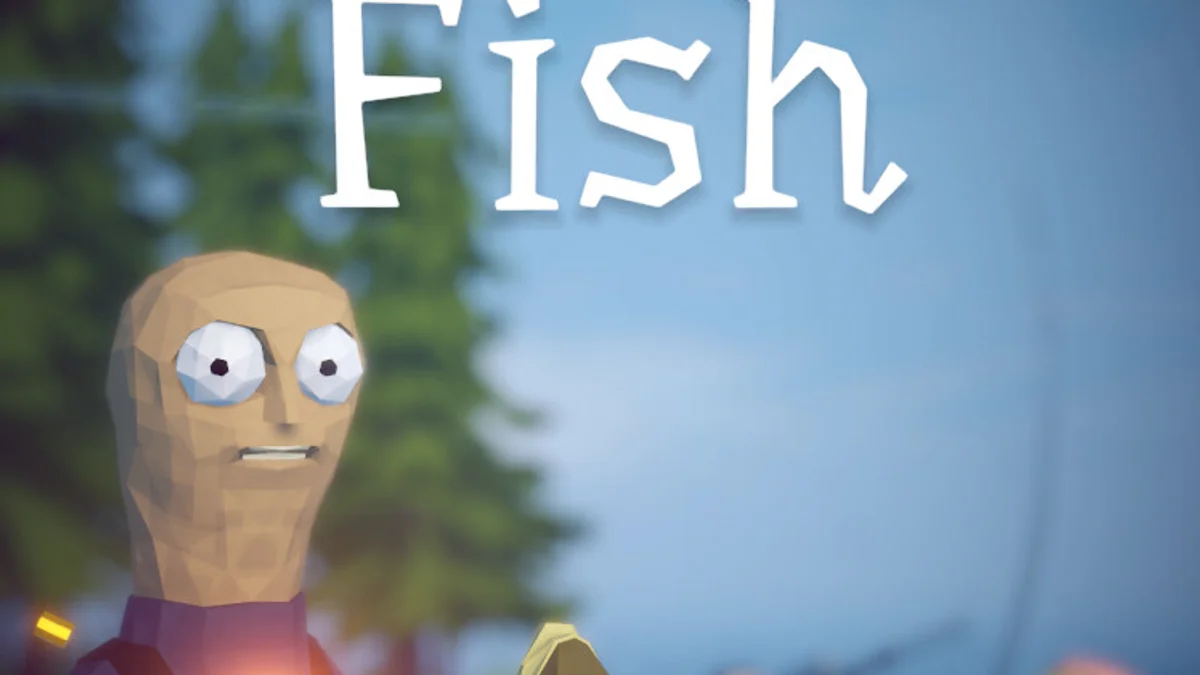
How to Fish sold more than one million copies in two days.
That is a strange sentence for a game made and self-published by Dazed Games, a Swedish team whose public website identifies only co-founders Melvin Olsson and Carl-Vilhelm Johansson.
The game itself has a similarly economical pitch. Catch fish. Kill fish. Sell fish. Buy increasingly inappropriate equipment.
“Friendslop” is a joke term describing a very real market
GamesRadar explicitly places How to Fish inside the current “friendslop” boom: cheap cooperative games whose entertainment value comes primarily from what a group does to simple systems.
The label is deliberately dismissive, but the pattern is increasingly recognizable. Low purchase price. A premise that can be explained in seconds. Physics or social systems that generate clips. Heavy dependence on voice-chat chemistry.
How to Fish fits almost perfectly.
Discord provides the narrative the game barely writes
PUG Empire gives the authored story one of its lowest individual scores. The setup is enough to move players between islands, not enough to carry the experience.
The memorable stories are created elsewhere.
Somebody gambles away the money. Somebody misses a fish. A boss appears during an unrelated plan. A teammate abandons efficiency because a ridiculous trick shot might pay more.
Those moments are not scripted, yet they become the stories a group remembers.
One million sales is more than curiosity traffic
GamesRadar reported one million copies sold within two days. Five days after launch, How to Fish passed 370,000 concurrent Steam players.
SteamDB still showed tens of thousands playing simultaneously on August 31 and more than 40,000 reviews with a satisfaction index above 90 percent.
Those numbers do not prove quality. They demonstrate that a sub-$10 cooperative game can become a global event without anything resembling AAA marketing expenditure.
Its small scale is both product strategy and weakness
Playcritik gives the game 8.0 while openly calling it shallow by design. PUG Empire scores it 7.82. GameBrief lands at 7.6 and is particularly critical of the solo experience.
The reviews largely agree on what exists.
How to Fish is not secretly enormous. Its island progression and systems can be exhausted relatively quickly.
For a group that rotates through inexpensive co-op games, brevity can be useful. For anyone looking for a new permanent hobby, it is a substantial limitation.
A two-person developer suddenly had to operate at blockbuster scale
Patch 1.0.4 expanded official lobbies to eight players almost immediately.
Subsequent updates added private sessions and addressed save problems, boss balance and griefing. Patch 1.0.10 arrived only a week after launch.
That frantic maintenance cycle has become part of the game's cultural story: an extremely small studio discovering in public what happens when a compact joke game attracts a blockbuster-sized audience.
How to Fish may not need to last forever
The standard question after a viral launch is whether the player count can be sustained.
Dazed Games has already said more content is planned. But How to Fish does not necessarily need to become an endless service for its success to remain meaningful.
At this price, a few memorable evenings can already constitute a complete value proposition.