This is adaptation, not an anime filter
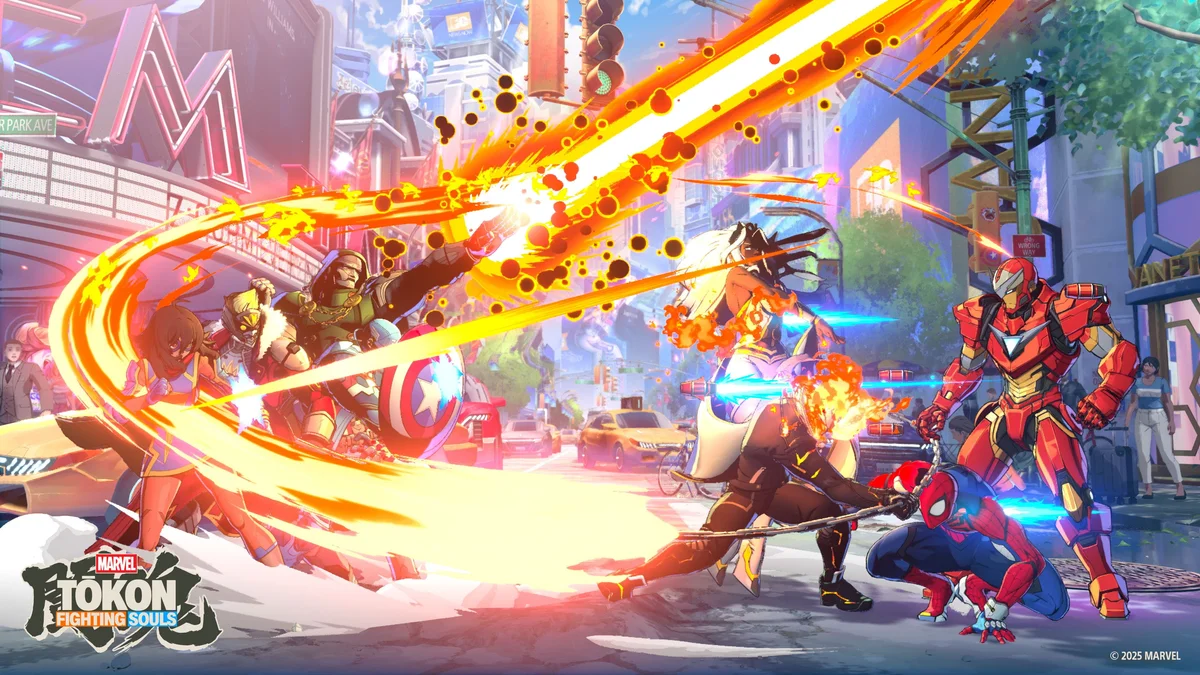
Arc System Works does more than redraw Marvel characters with sharper silhouettes and louder poses. Tōkon translates them into the studio's visual grammar: held frames, explosive transitions, exaggerated impact, graphic colour blocks and compositions that can evoke manga without erasing the American comic-book foundation underneath.
The result works because neither side completely dominates. Spider-Man still reads instantly as Spider-Man, while Ghost Rider, Storm and the rest can move and emote with an intensity that belongs unmistakably to Arc System Works. It feels like interpretation rather than brand compliance.
Five episodes keep the scale deliberately small
Episode Mode contains five original stories presented as animated comic sequences. Kieron Gillen wrote the scenarios, while different artists and colourists give the team campaigns distinct visual identities. Several reviews highlight the presentation and characterisation, including Push Square's praise for the treatment of Robbie Reyes.
That anthology-like structure is a smart fit for twenty launch characters. Each team can establish its own relationships and tone without forcing every hero into one oversized plot. When the writing lands, a few lines of dialogue and a strong panel composition do more for a character than another world-ending exposition dump would have.
The trade-off is narrative weight. The stories can be formulaic, and reviewers disagree more strongly about the solo offering than they do about the combat. The Guardian found the campaign comparatively slight, while other outlets were more positive about the broader set of offline activities. None of them turns Episode Mode into the game's main event.
Personality exists inside the moveset
Tōkon is at its most persuasive when character writing and fighting-game design stop being separate topics. Movement, attack poses, assists and supers continually reinforce personality. A fighter is characterised by how they enter a scene, occupy space and react to a partner just as much as by what they say between matches.
Stage transitions contribute to that theatrical quality. They alter the location while helping expand the active team, allowing a mechanical escalation to double as a Marvel set piece. The game does not need to stop for a cutscene every time it wants to be cinematic.
A supporting story mode, not a substitute for the fighter
All-Star Arena and other offline activities add variety, but the narrative centre remains those five compact campaigns. Players looking for a sprawling superhero adventure will exhaust the authored story material relatively quickly.
The restraint has an upside. Tōkon rarely forgets that its most expressive storytelling tool is still the roster itself. The solo mode is too slight to carry the package, yet its art, writing and character work give this Marvel interpretation enough personality that the fights feel attached to a specific world rather than a licensed collection of mechanics.